When discussing WEALTH, most people focus on the economic aspects of wealth. But ECONOMICS is only a small part of overall LIFE WEALTH. Life wealth covers all aspects of life, including, economic, physical/health, psychological and social areas.
Social wealth
This is about the RELATIONSHIP CONNECTIONS that you form, and can include good and bad. Relationships with family, friends, colleagues, bosses, subordinates, even strangers. Think about the positive relationships you establish and the negative ones. Increasing well-being, means deepening the positive relationships and ditching the negative ones. Align your energy with those that feel good, and positive. Having a good social SUPPORT NETWORK, and personal BONDING is a fundamental need for the human species.
How do you know if a relationship is positive? Ask yourself honestly, if you feel a greater sense of your BEING, an expanded version of yourself. You are MORE, in the company of a particular other person. You can be true to yourself, and the relationship JUST WORKS. There are no downsides. You accept the other people for who they are, and they accept you. If it’s a case of they are great when not [blank], then consider how often they are [blank], is this a price worth paying. The blank could be drunk, angry, on drugs or a myriad of other things.
You have to take the person as a whole, their good aspects and bad aspects. Don’t try to mould people to fit what you want, let them be who they are. If it works on that basis, great. If not, move on, life is really too short.
Physical Health wealth
It doesn’t matter how economically wealthy you are, without good physical health, you just can’t enjoy the fruits of wealth to the same degree. Health is so much more of a blessing than money could ever be.
We tend to neglect physical health, taking it for granted until it is taken away from us. On the flip side, enjoying good health, makes everything else more enjoyable.
Now I’m not saying you can’t have a good life without good health, because you can. You have to make the best of the hand life deals you. Some of the most extraordinary people in the world today, suffer from bad health and illness, but through the frailty of their form, shines through the light of their spirit. They can be an inspiration for others.
The point I’m trying to make is, don’t take your health for granting, look after it, and appreciate it.
Psychological wealth
Psychological wealth, includes intellectual and emotional aspects of personality. Emotions are triggered by our thoughts, which also have a bearing on most everything we do, including our social connections and how we treat our health.
Our thoughts are what shape our beliefs and values, which in turn affect our perceptions and interpretations about life and everything in it. What you focus your thoughts on, beccomes your reality. Therefore the quality of your thoughts, determines the quality of your life. Check out our wellbeing guide for more information.
Mental health is getting more attention today, than it has ever has before. It is a really big issue. Life today seems to be too much for some people to cope, overwhelmed by their perception of the complexities of modern life, the rapid rate of change, seeming lack of security, consistency, and stability economically and politically. People locked in EGOIC STRIVING for more and need for growth, are put under tremendous social pressure to achieve success, or be labelled a failure. Interpreting a breakdown in the sense of community, lack of emotional support and parental bonding can also impact negatively on psychological wealth.
On the positive side, having a positive mental attitude, the freedom to be yourself, to be true to who you are, the courage to follow your dreams, a positive self image, acceptance of the good and bad of what makes you, you, can have a major positive impact on your psychological wealth.
Economic wealth
So let’s give it some attention, economic wealth, is what most, or at least, a lot of people are fixated with. Wanting more is a structural part of the Ego, where WANTING is often more important than HAVING.
Having the burden of debt or liabilities has a negative impact on you, while having savings and assets, a positive one.
Pulling it all together
Like a balance sheet, positive aspects are weighed against the negative aspects of each of the wealth categories PHYSICIAL, PSYCHOLOGICAL, SOCIAL, and ECONOMIC. The aim is to have a positive perspective for each to increase your overall LIFE WEALTH.
I’ve weighted the categories in order of importance (from my perspective).
PSYCHOLOGICAL and PHYSICAL HEALTH WEALTH = each is 5/16
SOCIAL WEALTH = 4/16
ECONOMIC WEALTH = 2/16
You might have a different order than mine, it doesn’t really matter, as long as you consider them all when coming to a judgement of your wealth status.
The initial inspiration for this article was taken from actualwealth.com. Check it out by following the link. We have built on the model presented there, making a number of adjustments, taken from our own experiences and understanding.
This article is about using KEYWORD RESEARCHto understand how customers are finding you, or your competitors on the net. It is a look into the psychology of the people looking for your products or services. Use keyword research to GET RESULTS online.
What is keyword research?
There are a number of tools available online, that allow you to see what people are typing into search engines like Google, when looking to buy from businesses like yours. You can use these keywords to better understand your prospective customers, and apply the same search terms to rank your website, so that it appears at the very moment, prospective customers are looking for a product that you sell. It’s the ultimate in matching supply and demand.
The information is provided to businesses looking to advertise through platforms like Google Adwords, and details things like monthly search volumes, and estimated cost per click (if you advertise on Adwords). This information can also be used for Search Engine Optimisation purposes, aligning your website with searchers intent, and the good part is it’s FREE traffic.
Remember your website is useless if it doesn’t appear when searchers type in a search query. If your site isn’t optimised for these same search terms, you won’t appear in the search results, which means you won’t get any relevant visitors and customers.
Google Adwords for instant traffic
If you have a new website it can take months for your site to appear in organic search results, depending how competitive your niche is, even if your site is well-optimised.
Using advertising tools like Google Adwords, allows you to rank your site much quicker. In fact, if you know what you’re doing it can be ranking on the first page of the search results, within minutes, but you will have to pay for this rapid success. The cost for which varies, depending on your niche. Let’s look at how keyword research works and what you can learn from it to benefit your business online. Prices per click can be as low as 30p or be multiple pounds depending on how much money can be made by advertisers. Insurance companies tend to have a CPC of as much as £5-£10. Florists can pay £2-£3 per click.
At that cost, you really don’t want people just looking for information or searching for pretty pictures, clicking on your ad and costing your £2. You only want serious buyers to do so, so you need to focus on keywords that include buying intent.
Let’s look at keyword research for a typical local business, floristry.
Keyword research for florists
“Flowers” is the top searched-for-term, relating to florists, however it is too general, it could include searches for photos of flowers, or for information to identify flowers. There is no buying intent connected to this search term.
“Flower delivery” on the other hand is much more “buying intent” driven. People wouldn’t likely be using this search term unless they were looking to buy flowers or at least, find out information about flower delivery.
You would expect “flower delivery” to have a relatively high cost per click if it were purchase driven, which it does, at £2.81.
Other top search terms include:
Rose
Orchid
Plants
Florists
Lily
Funeral flowers
Flowers by post
Artificial flowers
Flower delivery UK
Red rose
Mothers day flowers
Send flowers
These are the top searched-for keywords. As you can see by this list there are a number of very general searches, which you would expect, with longer tailed searches being used less often. A long tail keyword would use more words, for example “cheap flowers online same day delivery” which had just 10 monthly searches compared to 201000 searches for “flowers”.
Get results; keyword research
If I were a florist, I would use from the list above, only maybe “flower delivery UK”, and maybe “Mothers day flowers”(if it were coming up to mothers day of course), “Send flowers” seems to be an information gathering search term on the face of it. All the other terms would be fine to use for Search Engine Optimisation purposes, but not for Pay Per Click advertising, where each click is going to cost you.
If you’re a small business owner, and would like a full list of keywords for your business, please provide your email in the box below and we will get one to you, free of charge. If you’re an entrepreneur, you should try to figure it out yourself, you’ll need it going forward, if you’re intending to keep building businesses.
Below is an article I did back in 2013 regarding Keyword Research which was, at the time on another website, so I thought I’d include it here, as I think it contains some interesting material.
Get Results: Google Adwords
What is Keyword Research
Keyword research can be used in a couple of different contexts, the first would be by a business owner or niche website owner, looking to improve visibility on the internet, so that they appear higher up in search results of popular search engines such as Google and Bing. If you are such as business owner, this would involve finding out what your target market is typing into the major search engines to find the products, services or information that you provide. Once you have these keywords you can use them to optimise your website so that you show up in those very same search results. When I say “optimise your website” I’m talking about writing articles that are centred around those keywords, as well as adding the keywords to your page title, and description.
The second context in which you can use keyword research is when you’re looking to start a website from scratch and want to set it up solely around monetising it around adverts such as Google Adwords (where you are paid if someone clicks on an advert on your website). To do this you look for money keywords, which can be compared to ‘panning for gold’ where you sieve out all the dirt and soil (poor quality keywords) until you are left with little gold nuggets (money keywords).
The golden rules for gold nugget keywords are:
#1 Relevance – keywords relating to niche to attract ‘targeted traffic’
#2 Traffic – high traffic volume is best to ensure there is sufficient potential custom.
#3 Competition – low competition is best but not too low as this might be evidence of there not being much of a market.
#4 Commerciality – is the measure of high value keywords.
Keyword research can be done in Google Adwords for free, by simply signing up for an account, alternatively there are a number of software solutions available that will do more in-depth analysis of potential keywords such as Market Samurai which I have used myself in the past.
#1 Relevance
Relevance is important if you’re a business owner and have particular products to sell or already have a website in a particular niche. It is about finding keywords that will attract ‘targeted traffic’ This is traffic that is going to be interested in your offering, and who are likely to buy from you or click on the ads on your site.
If you’re using PPC such as Google Adwords, where you’re paying to drive traffic to your site then Keyword research is vital to make sure you’re not spending money on unnecessary clicks. For example If your selling ‘dog collars’ then you will want to remove keywords such as ‘training’ for instance, because these searchers are not looking to buy dog collars at this time. You can set such keywords as negative keywords in Google Adwords so that when someone types in this negative keyword your advert will not show, and you won’t be charged for an inappropriate click.
You will definitely want to include the word ‘dog’ as a keyword rather than something like pet, otherwise you might find cat searches are included in the results. Using long tail keywords can help qualify searches. for instance ‘buy dog collars’ is likely to qualify potential purchasers rather more than ‘dog collars’ would.
tip – Go to amazon.com and type in keyword, look at books section (relating to your niche), and look at the table of contents, and check some of key terms and add the interesting ones, and do further searches of these ‘semantic’ keywords. This tactic can be used for writing articles and also to find what subjects would be popular to include on your website.
If you fall under the second context of keyword researcher (described above) than relevance doesn’t matter as much because you don’t have a particular product offering. Whatever you make the website about, Google Adwords will match the advert content to your content. In this circumstance you want to make sure you are targeting niches and keywords that have a higher value, see #4 commerciality below for more information about this.
#2 Traffic
It is important to know the difference between “total searches” which are cited in most of the keyword research platforms and the volume of traffic you are likely to actually get on your website should you rank on the first page of the Google SERP results. Below is a table showing the typical breakdown for traffic that is likely in each of the 10 listings on the first page of Google
95-98% of traffic come from 1st page of Google
Even if you are #1 you won’t get all the traffic
Google position
clicks
Traffic per 1000
Incremental Improvement in clicks
1
42%
420
254%
2
12%
120
40%
3
8%
80
39%
4
6%
60
24%
5
5%
50
20%
6
4%
40
7
3%
30
#3 Competition
There are two important measures when looking at the competition for a particular keyword phrase the first is the amount of competition. Ideally look for a lower amount of Google searches ideally less than 30,000 search results for any particular keyword phrase, you can check this by going to www.Google.com and typing in your keyword to see the amount of searches found.
Secondly consider the strength of competition. It’s best to avoid competing with professional websites, that have been around a long time, and that are highly optimised for the particular keyword phrase you are targeting. Also avoid competitor websites that have lots of webpages and a lot of backlinks pointing to them. If the first page on Google or Bing is mainly made up of these kinds of sites you are unlikely to be able to outrank them, so it is better to avoid these competitive keywords phrases altogether. Of course you have little option if you have a particular product offering and these keywords are the ones used by your target market, in this circumstance, where you are unlikely to get a first page listing you may consider PPC (pay per click) advertising to get a first page presence.
#4 Commerciality
The commerciality of a keyword is how much a particular keyword is worth. Google Adwords is a bidding system for keywords and is based on supply and demand. The more demand for a particular keyword the higher the cost per click (CPC) for that keyword. This is a good indicator of how much money is being made on a particular keyword. If an advertiser is paying $10 per click for a keyword it is likely that they are making more than that from their website sales, otherwise they wouldn’t be willing to pay that to Google to drive traffic to their site.
So when your conducting any keyword research keep in mind these golden rules and your more likely to find those golden nuggets.
Check out market Samurai’s explanations below of each of the golden rules. Useful information even if you aren’t considering using their software.
Relevance
Traffic
Competition
Commericality
Promotion
Track your Ranking
Market Samurai is a great tool which saves you valuable time and helps give you a greater insight into your keyword selection. Alternative you can use a free service provided by Google called Google Keyword Planner. You need to sign up for an account to access this online tool, but it’s a great resource. However it’s not as good as Market Samarai in terms of depth and insight. In fact MS uses your Google Keyword planner account to access much of the data needed but is much better at organising it for analysis.
Get Results: We judge ourselves by our INTENTIONS and others by their ACTIONS
Many people provide a true projection of who they are. They are true to themselves, and are easy to read. What you see is what you get.
However some people can initially appear to have certain characteristics or attributes, but when we get to know them better, you find they are not really “like that”.
I consider myself a good judge of character, but occasionally I have had an instant dislike for someone, only to grow fond of them over time. Why have I misjudged them?
I have also had a view of myself, that has differed from the view others have had of me. How can this be?
How do we misread how others think of us? How can we think we are coming across one way, when indeed we are coming across completely differently from the perspective of others?
One example that jumps to mind from recent experience, is the boy racers that rev their engines, screech off from lights, wheel spinning as they go, only to be sat waiting at the next set of lights, when you catch them up. They deeply believe they are projecting coolness, male prowess and demonstrating what a catch they are for the opposite sex. When indeed they look immature, and quite ridiculous.
It can be a real problem, if we see ourselves one way and everyone else see us another, particularly if the two views greatly contrast. If we think of ourselves as warm , friendly , approachable, and likeable and others see us cold, abrupt, unapproachable and not very likeable there is a real disconnect that can be very problematic for our business and personal lives.
Now there is an element of showing your best side, when you first meet strangers, and showing your true colours later, when you get to know people better. But we’re not talking about this, we’re talking about the discrepancy of what you think you are projecting, compared to how others perceive you.
So why can there be such a disconnect for some people? Stephen R. Covey explained “We judge ourselves by our intentions and others by their actions.”
This is where the discrepancy lies, we judge ourselves differently to how we judge others, and how we judge others is closer to how others actually judge us.
When perceiving yourself you have lots of background information. You understand your intention, what you’re trying to achieve by your actions. You are more likely to blame situational factors if things don’t work out as planned. You are also privy to your mental and emotional state at the time, and their influence on your behaviour.
When you perceive others, particularly in relation to people you don’t know very well, you’re likely to consider their behaviour as much more representative of the persons underlying character, and a truer reflection of WHO THEY ARE, without much consideration for situational influences.
Likewise, this is inevitably how they will perceive you. They are likely to interpret your actions as an indication of your personality. This difference in how we perceive ourselves versus how others perceive us, is referred to as the Fundamental Attribution Error or attribution effect.
It describes the tendency to overestimate the effect of personality and underestimate the effect of the situation in explaining other people’s actions. For example, if you are in a rush, and cut someone off in traffic because you have to get to the hospital to care for a loved one, you will interpret cutting the person off as totally justifiable. You are not a jerk, in fact, you are trying to help someone. The person you cut off, however, will have no idea you are going to the hospital, and will likely think you are a jerk.
How we see ourselves is intrinsically connected to our self-image, which is developed through our life experiences. A poor self-image can deeply affect our relationships and interactions in the world, which in turn, are perceived, by others, as being who we are, without the deeper understanding of why we may act this way.
A theory coined by Charles Horton Cooley provides us with insight as to how we see ourselves. The concept is called, “The Looking-Glass Self.” As each individual interacts with others in society, a relationship develops. It may last only a few seconds, yet our perception of how others view us, shapes our image of ourselves. It is like looking to a reflective glass for a glimpse of what it is like to be “us.” Cooley’s theory suggests our perceptions of how others see us, inevitably shapes our image of ourselves.
So if you find there is a disconnect between your view of yourself, and that of everyone else around you, there is a need to improve your self-awareness. Be wary that your attempts to be appear confident, aren’t being misinterpreted as arrogance. That trying to appear witty isn’t being seen as sarcastic, cutting or uncaring. Put yourself in the other person’s shoes, and try to be empathetic to their viewpoint.
Better still, don’t try to put on an act, and instead let your behaviour be a true representation of who you are, without the insecurities, and fears that might cause your behaviour to be undesirable. Embrace your inner being, and let your light shine through.
Check out my article about spirituality and wellbeing, that might give you some insight into letting your true self shine.
Get Results: Being healthy isn’t a fad or a trend, it’s a lifestyle
Why do some people stick to a healthy diet, and a productive exercise routine, while others don’t?
If you’re not exercising regularly (even if it’s just regular walking), and you’re not maintaining a healthy weight, you’re not living a healthy life, and you maybe, should be making a change. We all know it can be difficult to shed the pounds, especially as we get older, but most of the reasons for not following through on a healthy lifestyle, are largely due to motivational issues, rather than physical constraints.
ALWAYS CONSULT A DOCTOR BEFORE UNDERTAKING ANY PHYSICAL ACTIVITY AND DIETARY PLAN. THERE ARE SOME MEDICAL CONDITIONS THAT CAUSE EXCESS WEIGHT, SO CHECK WITH YOUR DOCTOR FIRST.
it is common knowledge, that a mixture of good diet and regular exercise is required to maintain a healthy weight and lifestyle, so we will be dealing with both in this article. I’m not going into the particulars about what foods to eat and not eat, and what exercises to undertake and what to avoid, in this article, it’s more about strategy, then execution.
Let’s look at some of the reasons and excuses for not sticking to a good diet and regular exercise routine and then what we can do about them. I have separated them out so that we can deal with them in turn, some of the points are repeated for both, where applicable. These are based on my experience, you may find some of the points apply to you, and some may not. It is recommended that you make your own list.
Self analysis
Not sticking to diet/eating plan
Giving in to a moment of weakness
Giving in to the urge/hunger
Inability to resist/delay (taste) gratification
Crave the taste/experience of (unhealthy/fatty food)
Think “will cut back tomorrow to make up”, but then don’t – (rationalise breaking the rules)
Procrastinating “I will start tomorrow/next week/new year”
What we can do about it
Realise there is only ever this moment, so act NOW.
Don’t believe or fool yourself and your rationalisations – resist the temptation
Frame nice tasting food, negatively
Make healthy food more appealing and enjoyable
Fill yourself up on water (no calories), so you don’t feel hungry, sometimes thirst can be mistaken for hunger
Keep your mind busy, so you don’t think about food out of boredom
Avoid distractions and temptations altogether (no chocolates in cupboard)
Have an accountability buddy, or some mechanism for holding yourself to account
Set yourself a goal, that has no wriggle room and set a deadline to achieve it, hold yourself to account. So you will be embarrassed if you don’t achieve it
Set yourself an achievable target, that allows you to enjoy eating some treats (as part of the plan), then have zero tolerance for coming off plan. Mark X’s on a calendar each day you stick to your plan, don’t break the row of X’s
Make it part of your lifestyle, who you are, what you do. Make it a good habit. Once it becomes part of your routine, it will be easier to stick to.
Not exercising
Want to do something other than exercising, like watching TV, working on laptop.
Don’t want the discomfort of going outside, or having to pay and go to the gym, and missing out on doing more fun things.
Lack of energy willpower, can’t be bothered – lethargy.
Would rather be doing anything else – don’t enjoy exercising.
Procrastinating “I will start tomorrow/next week/new year”
What to do about it
Realise there is only ever this moment, so act NOW.
Try to undertake exercise that is fun to do – has a social element to it
Exercise in front of the TV, so you can do both
Remove the temptations or distractions, so you can’t do them anyway, even if you don’t exercise.
Do short bursts of high intensity, do them in advert break.
Have a accountability buddy, or exercise with one
Set yourself a goal, that has no wriggle room and set a deadline to achieve it, hold yourself to account. You will be embarrassed if you don’t achieve it
Don’t think about it, just set a routine and stick to it – make yourself do it, once it becomes a habit, it will get easier.
Set yourself an achievable target, that allows you to enjoy some treats or veto’s, then have zero tolerance for coming off plan. Mark X’s on a calendar each day you stick to your plan, don’t break the row of X’s
Make it part of your lifestyle, who you are, what you do
I have put down some of the things that go through my mind when I’m faced with the choice of either eating something I want to eat or eating healthy, and with regards to exercising or not. You should add your own excuses to this list as part of your self-awareness analysis.
Conclusion
First set yourself a GOAL, give yourself some room for TREATS, otherwise you will be miserable (thinking you are missing out too much) and will be unlikely to keep it up. Your goal has to be sustainable, and enjoyable, if possible. Some exercise is better than none.
Develop a PLAN OF ACTION to achieve your GOAL. Set to a timeline, with a deadline. In doing this, you have to tap into your SELF AWARENESS, and figure out why you’re not doing what you need to do, or find out why you’re doing things that are counter-productive to your goal. Try to manage your weaknesses. For example, If you can’t pull yourself away from the TV, stick a treadmill in front of it and do exercise while watching TV.
Then you have to TAKE RESPONSIBILITY. There is no short-cut, or magic formula (be very, very careful about taking slimming aids and quick fixes, they can result in untold damage to your body). Stop making excuses and blaming other people or circumstances and the stresses of life, for not following your plan.
TAKE RIGHT ACTION. Those that take RIGHT ACTION have made it part of their routine. They JUST DO IT. They have found a way to JUST MAKE IT HAPPEN. It can be difficult to go against your bad habits, so either find some form of HACK to fool yourself into complying, or just make yourself do it.
Finally, be COMMITTED to your goal and plan of action, see it through to a successful conclusion.
Below is an inspirational video with quotes and affirmations from the “Law of Attraction” teachings.
Check out the “Law of Attraction” which is the idea behind the popular movie “The Secret”. However I would suggest checking out some of the videos done by Abraham Hicks on youtube for some really interesting in-depth videos about the subject. I recommend keeping an open mind when approaching the subject.
The 3 laws that are detailed by Abraham Hicks are:
The Law of Attraction – says “That which is likened to itself is drawn” and refers to the magnetic power of thought
The Law of deliberate creation – says “That which you give thought to or that you believe, allow or expect, is” we are all creators, most thoughts are by accident or default but holding deliberate thought will allow it to grow stronger and manifest itself into our life, good or bad.
The Law of allowing – says “I am that which I am, and I am willing to allow all others to be what they are”
You must understand the first before you can understand the second, and you must understand the first and second before you can understand the third.
Author Napoleon Hill also advocates the use of the Law of Attraction in this book Think and Grow Rich. He outlines the stages that need to be taken to live a fulfilled life:
Develop a burning desire, have faith, learn how to feed constructive ideas to your subconscious mind, acquire specialized knowledge, put your conscious mind to work, have a written plan, be decisive, be persistent, join forces with like-minded individuals, understanding the function of sex as related to success, understanding the power of the subconscious mind, trust your inner voice or six sense.
Although the book was written 1937 many of its teachings are still relevant today and is certainly worth a read. If you search there are a number or free PDF downloads available and the book is also available from Audible.com in audio form.
In a nutshell the premise of the Law of Attraction is:
Whatever you focus on, good or bad, you get more of. So be careful what you lock your thoughts on. Try to positively frame things in your thoughts such as wanting to be rich, instead of not wanting to be poor. If you think of poor, even in the negative you will get more of it in your life. The law of attraction does not understand the difference between not wanting or wanting. If you think poor, even in not wanting to be poor, that is the overriding focus of your thoughts and as a result you will get more of it in your life. So just to clarify, if you don’t want to be poor, think about being rich.
Just thinking of something is not enough, it needs to be mixed with a strong emotion to really work. so desiring something with all your heart will be more effective. So will fearing something. If you fear something greatly and keep that fear in your mind, you will, like a magnet attract that very thing into your life…so be warned!
Don’t just wish for something, believe it is waiting for you in the future, just waiting for you to meet up with it. Believe it is already yours, it’s just waiting for you to claim it.
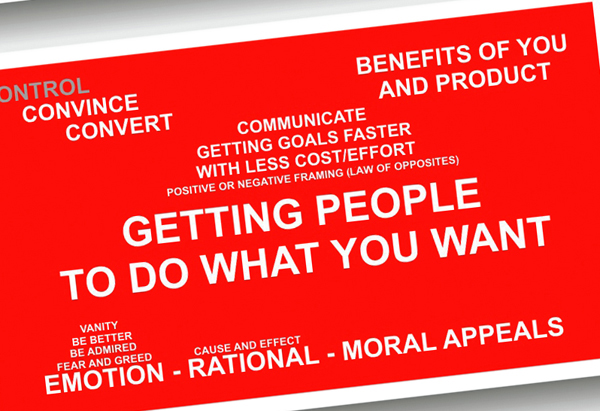
There needs to be at least two parties involved in the persuasion process, these being the…
Sender of message
Receiver of message
For the purpose of this article, we are going to look at how persuasion is used within MARKETING although it is used in many other real world situations, with good or bad intentions. One of the best ways to protect yourself from its influence, is AWARENESS. If you know how it works, you can defend yourself against it.
As Marketers we are, in our role as “sender of message” ultimately hoping to persuade the “receiver” to buy our product, there are a number of ways we can do this. The bare bone approaches being:
Control
Convince
Convert
Control
If we have power over the receiver we can use this to pressure them to buy. Power can come from..
Using your authority, if you have it,
The lack of options open to the receiver (no substitutes or alternatives available),
If receiver is desperate,
The scarcity of time to make the decision.
The receiver may feel their hand being forced, which might well lead to a feeling of resentment and resistance and is not likely lead to any kind of ongoing relationship, loyalty and bonding between the receiver and sender. I personally, don’t like to be pushed, manipulated or forced into buying, and I’m sure most people feel the same.
Hard sales tactics are often used by the sender, when trying to invoke some level of control over the receiver, and are common in the following circumstances:
When PRODUCT is temporary, limited use, or one-time use: fads, fashions, entertainments, seasonal clothing, equipment, perishable foods, collectables
When SELLER is temporary: door-to-door selling, telephone solicitations (“boiler room”), fly-by-night operations (“one shot”), con games (“pigeon drop”)
When BUYER is temporary, that is, in an unfamiliar area or condition: tourist, travelers, newcomers, inexperienced, immature
When a sense of CRISIS exits (a real or imaged emergency, time limit, or deadline): pain, genuine close-outs, elections, TV “shopping clubs”
When GUARANTEE (refund, or return of goods) is missing: unknown companies, “fronts”
When DEMAND exceeds SUPPLY: SURPLUS situations
Let’s look at a couple of real life examples: Some caravan parks limit the maximum age of caravans on their site, to say, 10 years old and then force caravan owners to buy a replacement new caravan from them, rather than from 3rd party suppliers.
Cinemas often discourage or even stop customers bringing their own refreshments into their venue, so they have to buy them from the foyer, at inflated prices. This control is enforced by the venue as a condition of using its facilities.
Convince
“Convincing” the receiver of your message to take a particular course of action, takes more effort than the “control” method, but is more ethical and rewarding. Getting attention is the first objective, followed by, creating a convincing argument that promotes your case and negates the alternatives. This is illustrated in Professor Hugh Ranks “Intensify and Downplay schema (see below).
If we present a clear cause and effect appeal to the receiver we will find our message more readily accepted from a rational perspective. So we must communicate the benefits and features of our offering and answer any objections that the receiver will inevitably have.
However emotional appeals have proven to yield better results because receivers engage the right-side of their brain more when emotionally aroused, as a result, they think less rationally, and are prone to act without thinking it through fully.
Intensify and Downplay Schema
Professor Hugh Rank’s model of persuasion, describes how promisers (marketers) intensify their own good and downplay their own bad. This model shows how marketers only tell receivers of product benefits using composition, association and repetition, But downplay any negative aspects by omitting this information, diverting attention away from it or trying to confuse. If you want to learn more about Hugh Rank’s model check it out here.
Pros, cons and objection handling
When I’m putting together a marketing message I look at the pros and cons of the product and note each down. I view the “cons” as possible objections and try to answer these objections, turning them into positives where possible. I also look at the benefits of using the product compared to not using it. Here is an example I have done recently for Thrive Landing page WordPress plugin to illustrate the process I use myself.
Positive/pros/for – ask why would they want to buy the product and keep asking why to dig deeper
No coding needed – drag and drop
No design skills needed – pre-defined templates
One off fee – No monthly recurring cost
One interface for website and thrive themes – within WordPress site
Professional looking landing pages
Better than many of competition because no subscription needed
Great support – fast replies via online forum
Lots of tutorial videos provided by Thrive themes
Negative/cons/against/objections (Turn these into positives where possible using law of opposites)
It isn’t free and costs $49 – better than having to pay monthly subscriptions like some of the popular alternatives such as Leadpages.
Negatives if not using product
Need to get a designer to do for you or learn HTML and have good design skills
Other options seem to include monthly subscription charges which mean when you stop paying you can no longer use the landing pages, with Thrive there are no monthly costs anyway, but the landing pages are built into your WordPress site so can be used forever.
With some suppliers you have to login to a remote interface to access your landing page editor
If you’re doing the HTML yourself and if you don’t have any coding skills these can be time consuming, look amateurish, and have limited template options
From this information I can now sell the benefits of the products
Selling Benefits
If you’ve done any marketing in the past, you’ll know about selling the benefits of your product. Getting these benefits over to receivers as early as possible is crucial to marketing effectiveness. Benefit seeking is the main driver of customer motivation. If receivers (customers) are looking for investment opportunities, their main motivation is “making money” or “preserving the value of their money”. So if you’re selling an investment product of any kind you need to communicate the making money aspect of your offer to appeal to the receiver of that message.
It is important to get the product benefits over to the receiver as early as possible, so it grabs their attention. The first thing a receiver sees on most marketing material, is usually the initial headline. Some examples of good headlines include:
You’ll never have Y (without X)
• You’ll never make money from your website (without having professional landing pages)
Buy X to achieve Y
• Buy Thrive Landing pages and make money from your website
How to achieve Y with less effort/cost/time
• How to make money from your website with less effort, cost and time
The Only Way to [Do Something Desirable] Without [Doing Something Undesirable]
• The Only Way to build landing pages Without learning to code HTML
[Do Something Hard] in [Period of Time] or [Promise]
• Make stunning landing pages in minutes or get your money back
[Do Something Desirable] Like [an Expert] Without [Something Expected & Undesirable]
• Make stunning landing page like a marketing expert – without any design or coding skills
Other examples
How to….
• How to Win Friends and Influence People
• How to Save Time and Get Things Done
Lists
• 7 Reasons Why List Posts Will Always Work
• 10 Ways to Beat the High Cost of Living
• Do You Recognize the 7 Early Warning Signs of High Blood Pressure?
Who Else Wants [blank]?
• Who Else Wants a Great WordPress Theme?
• Who Else Wants a Higher Paying Job?
The Secret of [blank]
• The Secret of Successful Podcasting
• The Secret of Protecting Your Assets in Litigation
Little Known Ways to [blank]
• Little Known Ways to Save on Your Heating Bill
• Little Known Ways to Hack Google’s Gmail
Get Rid of [problem] Once and For All
• Get Rid of Your Unproductive Work Habits Once and For All
• Get Rid of That Carpet Stain Once and For All
Here’s a Quick Way to [solve a problem]
• Here’s a Quick Way to Get Over a Cold
[Do something] like [world-class example]
• Speak Spanish Like a Diplomat
• Party Like Paris Hilton
See How Easily You Can [desirable result].
• See How Easily You Can Learn to Dance This New Way.
• See How Easily You Can Own a Lamborghini Miura.
Convert
This is the hardest of the three ways to persuade. Attempting to convert someone’s beliefs and values is really difficult because people hold them tightly and often associate their very being with deeply ingrained value and belief systems. If you’re message contradicts such values and beliefs you will need to provide hard factual evidence to back-up your message to have any chance of converting the receiver. However not all values and beliefs are made equal, and we may convert some, using emotional appeals that do not need complex reasoning to back them up.
The role of Emotions
Emotion makes people act in irrational ways and prevents them thinking clearly, and marketers know this and attempt to use it to their advantage. Many big organisations with vast marketing budgets look to get some incite into their customers inner workings, finding out what they like and dislike and what presses their buttons. They track shopping habits and develop marketing messages designed to get them to take action. Even small businesses need to have an understanding of who their customers are and what they want. The easiest way to do this is carry out surveys, hang out where prospects hang out, ask existing customers for feedback and run test campaigns online offering searchers a choice between options and measuring what choices they take.
Many large companies try to associate their products with popular celebrities, hoping some of that popularity will rub off on their brand. They know that if our idol tells us it’s good, we are more likely to act on their endorsement. On the flip side, if a celebrity encounters controversy, brands are quick to cut ties, and end sponsorship deals so that they are not cast in the same negative light.
If people are made to feel fearful that their family might be in danger, they are more likely to buy a security system, if they are scared their family will be left to struggle if they were to die, they are more likely to buy life insurance. If someone describes how we can live life on a sunny beach, having an amazing time with our families and have no money worries ever again, working a job that takes just thirty minutes a day, simply by reading a $99 Ebook, or joining the latest magic money making system, yes you got it, we will buy the Ebook, if we believe what we are being told.
The emotions of greed and fear are the most often targeted ones, but other emotions like curiosity are often used to pull the reader into marketing messages.
“Check out the one plugin that will turn your website into a money making machine”,
“If you’re not enjoying success online, this is the one thing you NEED to become a success”,
“What Everybody Ought to Know About making money online”.
People are very curious creatures, it is hard-wired into the human psyche and it’s very difficult to ignore curiosity laden statements or headlines. However the subject needs to be relevant to the interests of the reader. or it won’t work.
Summary
Persuasion is a fascinating subject, and the more that is understood about human psychology the more sophisticated the marketing messages will undoubtedly become. The key points to remember are:
Have a clear understand of who your customer’s are or are likely to be
Craft marketing messages from your customer’s point of view (what’s in it for me)
Sell the Benefits of your product, this is the core reason for them to buy
Pre-suppose their objections and tackle these head on
Find an answer to this prospects question “Why should I do business with you, instead of any and every other option available to me, including the option of doing absolutely nothing at all?”
Try to evoke emotion from your prospects to take action NOW
Add value, don’t try to manipulate your audience, try to persuade them that doing business with you is a win win situation, and make sure you mean it.
Manage expectations – Disappointment is based on expectations. Under promise and over deliver.
If you would like to learn more about marketing, check out our marketing guide.
The other day this saying randomly popped into my mind…
“Never ASSUME, it often makes an ASS of U and Me”.
Well it got me thinking about how ASSUMING impacts our lives. We often hear the word used when something has failed to happened, but which should have happened, because an assumption was made instead of checking. For example you might leave the house without your keys, only to realise after you’ve shut the door and locked yourself out, simply because you assumed your partner had picked them up.
That’s one example of assuming, others might include:
assuming we have the correct information,
assuming we are being told the whole truth,
assuming we have and understand all the facts,
assuming we know best.
I came up with this list while considering the current political debate ranging in the UK, where lot’s of strongly held opinions are flying around, based, to a large extent, on many assumptions.
So making assumptions can be very problematic, we should never assume anything, we should always double check, or do the research to make sure we have all the facts. Assuming is a form of laziness, which can cause us more hassle and pain further down the road.
I decided to look up the synonyms of ASSUME and came up with the following list:
taking for granted
taken as given
accept
conclude
consider
estimate
expect
guess
infer
presume
speculate
suspect
think
understand
ascertain
conjecture
deduce
deem
divine
fancy
find
gather
hypothesise
imagine
judge
posit
postulate
predicate
presuppose
suppose
surmise
theorise
be afraid
be inclined to think
count upon
fall for
get the idea
have a hunch
have sneaking suspicion
When I read though this list, it got me thinking about how ASSUMING is not just about missing something, or not checking if something has indeed taken place, it can also be a reason why we DON’T TAKE ACTION.
Think about it for a minute, if you assume you KNOW the outcome of say, a particular course of action, it might be enough to discourage you from even trying. Your internal inner dialogue might go like this…
“It won’t work”, or
“I’m not good enough to make a success of this”, or
“People aren’t going to buy it anyway.”
This might be an assumption based on nothing more then self-doubt, but if you just assume you can’t do it, or assume it won’t work out, you aren’t likely to take the necessary steps to find out.
Stop ASSUMING, it’s a motivation killer. The only way you can know for sure is by giving it a go.
Get Results: Marketing is about providing the right offer, to the right personal in the right place at the right time
Marketing is a subject close to my heart, mainly because it taps deeply into human psychology, and I love trying to figure people out.
The trouble with marketers is they try to game the system all the time, trying to find shortcuts and quick wins, which often means being content with making a quick buck and lacking any kind of long game.
I like marketing when it is used to make people aware of genuine solutions to genuine problems, I like it when it’s used to help people. “The best form of selling is helping.”
Adding value to someones life, and earning something for doing so, means you get to help someone else. That’s the best use of marketing, long term.
So if we are to distil Marketing down to its core, what is it?
Is it the exchange of value? Well “no”, the actual sales transaction is the value exchange, you provide a service or product and the customer pays you for it. Until that happens there is no value exchange.
So what is marketing at its core? How about, the getting and keeping of attention. Sure, good marketing does that, but there’s much more to it then just that, like knowing how to capture attention by targeting the right prospects, and understanding what they want and need. Digging even deeper, we have to understand what prospects will value enough to part with their hard earned money, for. It becomes a rabbit hole of tunnels that are hard to summarise.
So what summary covers a more complete picture about marketing? Well, how about this one. Marketing is all about doing the following…
“Providing the RIGHT OFFER to the RIGHT PERSON, in the RIGHT PLACE at the RIGHT TIME.”
I think that just about covers the necessary basics.
“Providing the RIGHT OFFER, to the RIGHT PERSON” – infers providing something the prospect actually wants or needs and is will to pay for, rather than trying to sell to people that have no interest in purchasing your solution.
“In the RIGHT PLACE at the RIGHT TIME” – infers marketing at a location where your prospects’ attention is going to be, and at a time they will be receptive to listening to you. Much online attention is currently concentrated on social media platforms, particularly for certain demographics, and if that is where your prospect have their attention, you should be there as well.
I would also add a couple of additional points, like giving prospects a reason to TRUST you, to LIKE you and see you as a CREDIBLE provider, but these only come into play once you do the other things RIGHT first and are a big part of your value proposition.
So what do you think. Do you have a better summary that nails what marketing means at its core?
Check out our Marketing guide for more marketing related content.
When it comes to moving closer to goals, by actually taking action, many people can’t even seem to get started. They come up with lots of excuses why they shouldn’t act. For example if you have a goal of becoming a successful business owner, or entrepreneur, you might say to yourself via your inner dialogue…
Justifications for maintaining the current status quo
It’s less risky to just keep doing what I am currently doing (not taking action)
I’m too busy with my current work and family schedule, I don’t really have the time to devote to pursue my goal(s). Working evenings will cut into my time with family an friends.
Possible negative consequences of taking action
It will take time, skills that I may not have
I could fail (so won’t take the risk)
I want to put myself in a situation where I’m being judged by others
People might think I’m fake, a fraud
I don’t know or might not know how to do it (what needs doing)
My idea isn’t good enough, or might not be good enough
I could waste lots of time, effort, money investing in something that just doesn’t work out, so why even bother
Success will mean working all hours and will have no time for family
I’m scared of pushing myself and doing things outside my comfort zone, because it’s uncomfortable
I don’t like asking people for help, and I might have to do
I don’t like asking people to buy from me, I just can’t sell
I might lose all my money
I might get ripped off by scam artist who takes advantage of my naivety
Talking professionally to people (in case they think I’m a fake)
I might be promising something I can’t deliver
I might ruining my reputation, when it’s very important to me
I don’t like giving presentations, pitching, speaking in front of customers, audience and might find I have to at some point
I don’t like the idea of putting myself out there and feeling vulnerable
I don’t like to rely /depend on other people, in case I get let down
If you’re trying to lose weight or get fit you might say to yourself…
Justifications for maintaining the current status quo
I love eating tasty fatty foods – they taste so good. I always have good intentions but when I’m hungry, I just give in
I want to watch TV rather than going out and exercising in the cold/at the gym
Possible negative consequences of taking action
Healthy food doesn’t taste as good as fatty food
Exercise is too hard, I don’t enjoy it, and can’t deal with the discomfort and pain
Issues with self esteem or even some degree of self loathing, can sometimes result in people finding comfort in binge eating, which further fuels self loathing and lowers self esteem. In such circumstances you should try to deal with the underlying root issues, as the eating is a manifestation of these, rather than the root cause.
Why you come up with excuses
This list of excuses, is your mind trying to rationalise the decision not to take action. On one hand you feel you should be doing something in pursuit of your goals, after all everyone says you should have goals, don’t they? On the other hand part of you fears taking the risk.
When you contemplate moving from your comfort zone, your current situation, and the routines and habits that you have, and maybe have had for some time, to something that feels new, you will naturally feel some level of fear.
You are hardwired, through evolution, to resist putting yourself in dangerous situations, and change is perceived as being potentially bad. Change equals uncertainty and uncertainty could result in risk and possible danger. Risk and danger is considered bad because your sense of self (who you see yourself to be) could be devalued in some way, and your survival instincts will do its level best to ensure this doesn’t happen.
All action is driven by the need to avoid pain and being destroyed, and all your actions are built on this one need. You continually strive for more, because being more means you are further away from being nothing. The more you have, the more you are. So you’re not a freak because you’re not taking action, you’re trapped by your fear of change, uncertainty, risk, danger, failure, you might even be fearful of success, or at least the consequences of success (no time to spend with friends and family, responsibility etc).
Moving beyond fear
So now we know why we aren’t taking action, we can move on to working out a strategy for overcome these limiting thoughts and beliefs.
The first thing to consider is how real these perceived dangers are and how seriously are they likely to impact you, should they materialise.
Without knowing your personal situation in more detail, it is difficult to give a specific answer, but general fears can be looked upon in the following ways:
Being judged by others
With regards to being judged by others, if you had more self confidence or self esteem, other peoples’ opinions would matter much less to you. Sure, we all like to be liked, but being dependant on other peoples’ opinions, is not healthy. You will tend to make up stories about how and why this and that person doesn’t like you, which is usually nothing more than a fictional story of your own invention and more about your own judgements of yourself, rather than theirs.
If another person doesn’t like you, and you know this for sure, because they have actually told you so, and for XYZ reasons then at least you know, rather than suspect. You can either try to adjust your behaviour, if you agree that it is unacceptable, or ignore their views, if you disagree. After all they might be accusing you of behaving unacceptably when they are the ones with the insecurities and esteem issues. Remember they are being driven by the same insecurities and fears that you are, and putting yourself in their shoes through empathy, allows you to realise this. They might be lashing out because of their own pain, rather than it being you.
I believe if you are truly joyous and genuinely happy and aligned inside, you have no reason to attack or belittle another person. Anger, frustration, fear and all negative emotions come from insecurities and pain within you, which is already there, but just being aroused by the situation you’re reacting to. Check out my wellbeing guide for more information, particularly the equation of emotion part which details how negative emotions are created.
Not good enough
If you believe you’re not good enough or not up-to-the-job. Try to understand where these thoughts are coming from. Again your self-preservation instincts will try to protect you from risky situations, but you can move beyond this by identifying your weaknesses and educating yourself into mastering them.
Low self esteem and lack of belief in yourself can be embedded deep into your psyche from early childhood, when you were very impressionable and filtered your experiences less. If your environment at an early age was not supportive, maybe you were continually told you were not good enough, or were not given enough love from one or more of your parents, whom you craved love from. Or you were discouraged to take risks or do things outside the norm, being told not to do something “for your own safety”, or told to fit in and not stand out, these fears and insecurities might still be lingering in the background of your mind, influencing your present decision making and possibly sabotaging your goals. None of these things can be considered as “truths”, they were opinions and actions from people who themselves were in some degree of pain, and may well have been just passing on their own insecurities and fears through their actions and words.
You can be good enough if you’re willing to make the effort and put in the work. If you don’t want to make the effort then you’re probably not going to get far, for that reason. Check out my work ethic article for more.
Now a caveat. Talent has a part to play in success, particularly when you’re competing with others to get to the top. You should look to play to your strengths, and you will have strengths as well as weaknesses. We all have weaknesses so don’t feel bad about them. I would love to be a singer, unfortunately I can’t hold a tune, I’m terrible, really. I could probably improve with training and purposeful practice, but I would never be able to go beyond my physical limitations. I might, with lots of practice, get good enough to perform at a certain level but I would never be at the top of the tree. Such limitations are true of some activities, singing, I would say is one, some kinds of sports that rely on certain physical characteristics and prowess, maybe another. But there are many more things that don’t have such limitations, you can practice and practice and become better, and be as good as you want to be. Often hard work trumps talent, when talent doesn’t work. Check out my article on self awareness, because this is key to identifying your strengths and weaknesses.
Fearing success
You might have an inner conflict of wanting to be successful, while at the same time fearing the consequences of success, like having no time for friends and family or relying on other people or being ripped off, or having to shoulder responsibility for yourself and others.
The best thing to do is examine these conflicts and resolve them. If you don’t want to work all hours and miss time with family and friends, then find a lifestyle business that doesn’t depend on your presence so much. Many large businesses have managers operating the business on behalf of the owners, so scale could work in your favour after the initial building phase. Some businesses, such as online businesses can be worked on around family time, or be outsourced/delegated to someone else. If you first, identify the conflict and confront it, you can then work out a solution to move beyond it. If you can’t resolve it, maybe you should drop that particular goal and find a different one that best suits who you are. It’s really no good trying to put a square brick into a round hole (check out my article on self awareness).
Conflicting wants
Wanting one thing (your goal), but also wanting something that is counter-productive to that goal, is obviously problematic. For example if you want to lose weight, be lean, get fit, but can’t resist eating fatty foods such as chocs, snacks, sweets, burgers and the like, you have a conflict of wants. You might have good intentions, but when the temptation is there, for example having chocs in the cupboard, you find it almost impossible to resist, without having a huge amount of self control and willpower.
Another example: If you want to get an assignment done, but can’t resist watching your favourite sports team playing, or can’t face pulling yourself away from the TV, then you have a a conflict of wants.
One solution is to avoid putting yourself in situations that provide temptations or distractions. If you’ve no chocolates in the cupboard, you can’t eat them. If there’s no TV, you can’t watch it. It all comes down to deciding your priorities.
Personally I can work on my laptop, while sat in front of the TV and remain 100% focused on what I’m doing. This means I don’t feel I’m having to lock myself away or miss out on anything. It encourages me to work more frequently and intensely, and really, the TV, even with the sound on low, doesn’t distract me. I find I’m more productive working that way. Find what works best for you.
Giving yourself a reason to take action
Life is all about making choices. You will take the action that drives you most. You will take the action that NEEDS to be done or else…., or that you really WANT to do. Check out my article about getting into a WANT or NEED state of motivation.
Give yourself a compelling reason to take action and you’re more likely to take it. Motivation has many elements, check out my motivational guide here.



 . He outlines the stages that need to be taken to live a fulfilled life: